Cloud Security Audit for UAE Government Cloud Migration: NCAP and Security Requirements
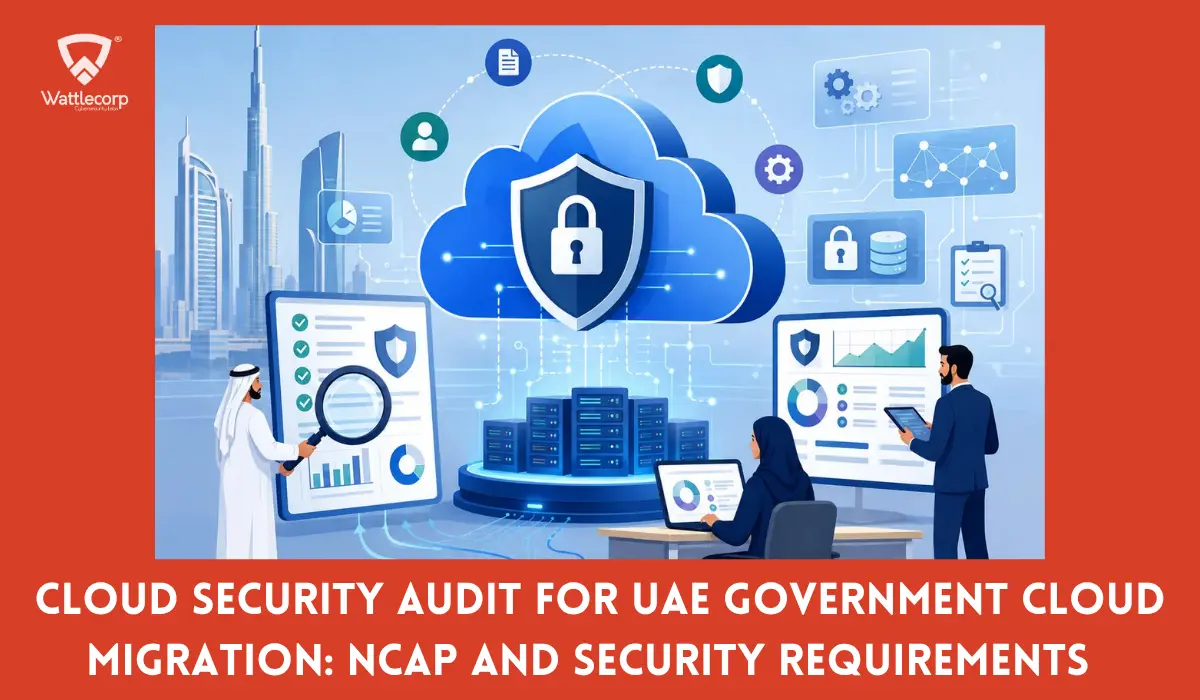
Key Takeaways:
- A cloud security audit UAE helps government entities identify security, governance, configuration, access, data-protection and resilience gaps, before and after shifting critical workloads to the cloud.
- UAE National Cloud Security Policy has defined cloud governance, data security, data sovereignty, IAM, incident management, resilience, portability and cloud operations requirements.
- The National Cyber Accreditation Program (NCAP), a framework by the UAE Cybersecurity Council sets uniform baseline cybersecurity, evaluation, accreditation, and certification standards for government entities, cybersecurity service providers, and training organizations.
- Dubai government and semi-government entities should additionally account for applicable DESC requirements that include the Information Security Regulation.
- CSPs providing cloud services to these entities are duly expected to comply with the DESC Cloud Service Provider Security Standard.
- Cloud audits should validate not only the CSP, but also the government entity’s own responsibilities for identity, workloads, configurations, data, integrations, incident response, and ongoing cloud governance.
Why Government Cloud Migration Needs Security Assurance from the Beginning
When Oracle Cloud Infrastructure successfully completed the Dubai Electronic Security Center’s Cloud Service Provider Security Standard audit, the milestone demonstrated an important principle for government cloud adoption: selecting a major global cloud platform does not eliminate the need for independent security assurance. The cloud environment still should satisfy the security expectations applicable to the government workloads it supports.
A government entity migrating citizen-facing applications, confidential records, APIs, databases, etc., into a new cloud environment may succeed technically. However, its privileged accounts may become excessive and storage permissions may be broader than intended, logs remain incomplete, encryption keys are poorly governed, and the disaster-recovery configuration go unverified. These instances signify incomplete security transformation.
Cloud security audit UAE gains prominence in such situations. It gives government IT, security, risk, and compliance teams structured evidence that the new environment has been designed and configured around UAE cybersecurity requirements, one that goes beyond successful migration.
Why Cloud Security Audit UAE Matters for Government Entities
Cloud migration changes infrastructure ownership, but doesn’t transfer every security responsibility to the cloud provider.
Government entities still need visibility into users, privileged access, workloads, configurations, sensitive information, applications, APIs, encryption, integrations, monitoring, backups, and third-party dependencies.
The UAE National Cloud Security Policy reflects these realities, requiring cloud governance, contractual agreements, data security and lifecycle management, data location and sovereignty, interoperability and portability, infrastructure and virtualization, identity and access management, incident handling, forensics, and resilience.
Also Read : How to Secure Cloud Applications with VAPT Services?
A cloud security audit UAE helps decision-makers answer practical questions such as:
- Where will government information be stored, processed, backed up, and transmitted?
- Who can administer critical cloud resources?
- Are privileged permissions genuinely necessary?
- Are storage services, databases, APIs, and management properly and securely configured?
- Can we detect, investigate, contain, and report security incidents?
- Can critical services continue operating if a region, service, account, or integration fails?
- Can information and workloads be securely migrated if the organization changes CSPs?
These questions carry more weight when cloud migration involves citizen information, critical government services, regulated workloads, or public and private systems integrations.
What NCAP means for Government Cloud Security Assurance
The UAE’s National Cyber Accreditation Program (NCAP), adds another important consideration to cybersecurity vendor governance.
Run by the UAE Cyber Security Council, the NCAP acts as a framework for consistent evaluation, accreditation, and certification of entities. It is programmed to help government entities, cybersecurity providers, and training organizations meet baseline national cybersecurity standards. It also enables government entities to work with provider organizations that conform with those baseline requirements.
Procurement of security-providers, under NCAP, should be qualified by data-backed risk management and local validation frameworks instead of relying on marketing claims or unrelated jurisdiction-led certifications.
Where NCAP accreditation requirements apply to the cybersecurity provider or engagement, government entities should verify the provider’s applicable credentials through official UAE Cybersecurity Council channels.
NCAP and cloud-provider-specific requirements are not the same as these operate at fundamentally different levels of the digital supply chain. While the former offers a structured framework to evaluate and accredit entities, including cybersecurity service providers, against applicable national baseline requirements, and competency expectations, the latter, i.e., cloud-providers decide how data and computing infrastructure can be secured, be it private or public.
NCAP accreditation of a cybersecurity service provider shouldn’t be considered a substitute for applicable CSP certification, Dubai ISR (Information Security Regulation) and DESC requirements, sector-specific requirements, or other government obligations.
What Should a Government Cloud Security Audit Cover in the UAE?
Cloud security audit UAE for government entities goes beyond reviewing Cloud Service Provider (CSP) certifications and paper policies to examine the actual technical configuration of cloud environments.
1. Cloud Architecture and Configuration
Auditors should review account or subscription architecture, network segmentation, security groups, firewalls, virtual networks, public exposure, storage configuration, management interfaces, workloads, and infrastructure-as-code controls.
Audits on these planes help identify configuration vulnerabilities that could have crept in during rapid migration.
Also Read : Azure Server Hardening for UAE Businesses: Securing Microsoft Cloud Against Misconfigurations
2. Identity and Privileged Access
Government cloud environments commonly involve administrators, developers, vendors, applications, service identities, and automated workloads.
The audit should assess MFA, role-based access, least privilege, privileged accounts, service accounts, federation, and conditional access, and separation of duties.
3. Data Security and Sovereignty
A cloud security audit UAE ought to establish clear visibility and control over the entire data lifecycle within the cloud environment. Doing so, should, in turn, consider data classification, location, where backups are held, how data moves between services, and how encryption keys are managed.
The UAE National Cloud Security Policy has specific requirements to address data location and sovereignty. This means cloud consumers need to understand where their data is stored, processed, and managed.
4. Logging, Detection and Incident Response
Migrating infrastructure without migrating security visibility creates a significant operational blind spot.
Audit teams should validate security logging, administrative activity monitoring, alerting, log retention, SIEM integration, incident escalation, cloud forensic readiness, and the responsibilities shared between the organization and CSP.
5. Resilience, Backup and Recovery
Cloud availability does not automatically equal application resilience.
Building a resilient cloud security UAE strategy is what matters to ensure data integrity and operational uptime at times of cyberattacks or system failures. Government entities should examine backup protection, redundancy, recovery architecture, recovery objectives, dependency, ransomware scenarios, and making appropriate business-continuity arrangements.
6. CSP and Third-Party Governance
Contracts should clearly define security responsibilities, incident communication, data location, migration or exit arrangements, and other applicable cloud-security obligations.
The Telecommunications and Digital Government Regulatory Authority (TDRA)-developed UAE Information Assurance Regulation addresses due diligence, cloud risk assessment, governance requirements, incident communication, and, where possible, retaining a right-to-audit cloud-provider security arrangements by outlining specific management and technical controls.
Audit Before, During, and After Cloud Migration
Cloud security audit UAE isn’t a one-time exercise that could be performed after deployment.
A pre-migration assessment helps reveal inappropriate architecture, data location concerns, risky provider dependencies, weak identity models, and compliance gaps, avoiding undue expenses for redesign.
During migration, security validation can help detect configuration drift, excessive temporary privileges, unintended internet exposure, and approved architecture-deployed infrastructure gaps.
A post-migration audit verifies the production environment and generates evidence for security leadership, risk owners, auditors, and other relevant authorities.
Periodic reassessment is critical, given the constantly changing cloud environments through new services, accounts, APIs, permissions, and application releases.
Building a Secure Foundation for UAE Government Cloud Adoption
Government cloud migration shifts to a rewritten playbook for resilient public sector IT operations, data security, and visibility.
A well-scoped cloud security audit UAE helps government entities turn those uncertainties into measurable security findings and remediation priorities.
Wattlecorp’s Cloud Security Audit UAE & Regulatory Compliance Assessment provides government entities, regulated organisations and enterprises with an integrated assessment of their cloud environments, combining technical cloud security validation with UAE regulatory mapping, data-sovereignty assessment, third-party assurance and cloud-provider due diligence.
Our DESC Cloud Service Provider Security Standard Assessment for UAE enterprises is designed to help organisations determine whether their proposed or existing cloud environment is secure, appropriately governed, compliant with applicable UAE requirements, and suitable for the classification and sensitivity of the workloads being migrated.
Cloud Security Audit UAE FAQs
1. What is a cloud security audit in the UAE?
2. What security requirements apply to UAE government cloud migration?
3. What is the DESC Cloud Service Provider Security Standard?
4. What should government entities assess before moving sensitive workloads to the cloud?
5. How do cloud security audits and VAPT support secure cloud migration in the UAE?

 Cyber Security Strategic Consulting for UAE Boards: Aligning Security Investment with the NCSS 2025–2031
Key Takeaways: The Cyber Security Strategic Consulting UAE programmes help organizations align their cybersecurity roadmaps with the five NCSS pillars, namely governance, protection, innovation, establishing and building, and partnership. Boards should connect cybersecurity spending to material business risks, critical services, regulatory duties, and measurable resilience outcomes. Cyber security strategic consulting UAE programmes translate national direction […]
 Mobile Application Penetration Testing for Qatar Government Digital Services: NCSA- Aligned Security Assurance
Key Takeaways: Mobile Application Penetration Testing Qatar must cover the app, device storage, APIs, authentication and third-party components. Qatar’s NCSA assurance environment combines the National Information Assurance (NIA) Standard, the National Information Security Compliance Framework (NISCF) and accredited security assessment services. OWASP MASVS defines mobile security controls, while MASTG supplies practical test methods for Android […]
 Qatar Data Protection Law: Implementing PDPPL Data Subject Rights Processes for Businesses
Key Takeaways: The Qatar Data Protection Law (Law No. 13 of 2016) for Personal Data Privacy Protection, grants individuals specific rights such as right to access, correct, erase, object, withdraw consent, and right to be notified of processing or inaccurate disclosure. Beyond having a privacy policy, businesses or controllers, under Article 11 of Personal Data […]
 AI Governance for Indian Enterprises: Building Internal Controls Before Key DPDP Obligations Take Effect
Key Takeaways: The DPDP Act does not contain AI-specific provisions. Its requirements, however, apply in situations when an AI system processes digital personal data within its territorial and material scope. India is working on building a broader governance framework around safety, accountability, transparency and trust via programs like the IndiaAI Mission. Indian organizations should inventory […]
 Cloud Security Audit for UAE Government Cloud Migration: NCAP and Security Requirements
Key Takeaways: A cloud security audit UAE helps government entities identify security, governance, configuration, access, data-protection and resilience gaps, before and after shifting critical workloads to the cloud. UAE National Cloud Security Policy has defined cloud governance, data security, data sovereignty, IAM, incident management, resilience, portability and cloud operations requirements. The National Cyber Accreditation Program […]
 Data Privacy Consulting UAE – Building a PDPL-Compliant Data Governance Program
Key Takeaways: PDPL compliance requires ongoing operational governance that goes beyond policies to demonstrate how personal data is collected, used, protected, transferred, retained, and deleted. Data mapping helps businesses move from reactive compliance to proactive risk management by establishing a comprehensive inventory of the data ecosystem, helping build a mature data privacy and governance program. […]