


Cybersecurity for Qatar Logistics & Port Operators: Protecting Digital Supply Chain Systems

Key Takeaways:
- OT systems controlling cargo equipment and port infrastructure are often among the most under-monitored and operationally sensitive layers in Qatar logistics security environments.
- A single compromised vendor credential can silently reach core logistics systems long before any alert fires in your SOC.
- Cybersecurity for Qatar logistics ports is a revenue protection issue, port downtime, SLA penalties, and cargo backlog all carry a measurable financial cost.
- A SIEM that runs without ingesting logs from terminal systems, cloud workloads, and vendor-connected platforms creates more false confidence than actual security visibility.
- Moving from annual assessments to continuous posture management is the most practical way for cybersecurity in Qatar logistics ports to keep pace with a threat landscape that does not follow an audit calendar.
Why Qatar’s Logistics and Port Sector Needs Stronger Cybersecurity
Qatar’s trade corridors handle billions of dollars in cargo each year. Behind every container cleared at a port terminal, every freight booking processed through a logistics platform, and every customs declaration filed digitally, there is a chain of connected systems that most organisations have never fully mapped from a security standpoint.
As port automation, cloud-based freight management, and IoT-enabled tracking reshape how cargo moves, cybersecurity for Qatar logistics ports has shifted from a background IT function into a front-line operational risk.
This is no longer a matter of protecting servers. It is a matter of keeping trade moving.
What makes Qatar’s logistics and port sector a high-value target is precisely what makes it operationally critical, time sensitivity, trade volume, and deep system interconnectivity.
Ransomware groups, supply chain attackers, and state-affiliated threat actors do not target logistics operations because of the data sitting on file servers.
They target them because a disrupted port creates immediate financial pressure, cascading cargo backlogs, and contractual consequences that force fast decisions under stress.
That combination of urgency and operational dependency is exactly what attackers rely on.
The Attack Surface Is Bigger Than Most Operators Realise
When security teams in logistics companies think about their exposure, they tend to picture firewalls and endpoints.
A typical Qatar port or logistics operator runs office IT networks alongside terminal operating systems, warehouse management platforms, fleet tracking tools, customs-connected APIs, IoT sensors on the warehouse floor, and a patchwork of third-party integrations connecting shipping lines, freight forwarders, and government portals.
Each of these are a potential entry point. OT systems, the operational technology controlling cargo handling equipment, access gates, and port infrastructure, are particularly vulnerable because they were not designed with network connectivity in mind.
They are difficult to patch, rarely monitored by SOC teams, and often excluded from SIEM log ingestion.
When an attacker moves laterally from a compromised vendor account into an OT environment, the consequences are not limited to data loss.
They can mean physical disruption to port operations.
This complexity is exactly why cybersecurity for Qatar logistics ports demands a different kind of thinking than a standard enterprise security programme.
What the Threat Landscape Actually Looks Like
The threats facing Qatar’s logistics and port operators are not theoretical. Maritime cyber risk is internationally recognized because compromised technology assets can affect shipping-related operational, safety, and security outcomes.
Ransomware groups have demonstrated a clear appetite for logistics targets precisely because downtime creates immediate financial pressure.
When cargo cannot be cleared, when vessel scheduling systems go offline, or when a freight platform becomes inaccessible, operators face compounding losses from SLA penalties, client dissatisfaction, and recovery costs.
Supply chain software compromise is another growing concern. Attackers have learned that targeting a widely-used logistics platform or ERP vendor is more efficient than breaching each operator individually.
A single compromised software update or vendor credential can provide access to dozens of downstream customers.
Business email compromise continues to be a significant revenue risk for freight operators, where high-value invoice transactions and trade documentation make well-crafted phishing attacks particularly damaging.
API exploitation is also increasing as logistics digital systems become more interconnected, poorly secured integrations between customs portals, shipping exchanges, and transport management systems often lack proper authentication and audit logging, making them attractive targets.
For security leaders working on cybersecurity for Qatar logistics ports, the priority must be understanding which systems are connected, which are monitored, and which are currently invisible to detection workflows.
Why This Is a Board-Level Issue, Not Just a Security Team Issue
Qatar’s National Cyber Security Strategy 2024–2030 makes a direct connection between cybersecurity resilience and national economic continuity.
Qatar’s National Cyber Security Strategy 2024–2030 places strong emphasis on cyber resilience and critical national infrastructure protection.
For logistics and port operators, this makes cybersecurity a business continuity and governance priority, especially where operations support trade, transport, and national economic activity.
Operators that cannot demonstrate measurable security maturity are not just exposed to cyber risk, they are exposed to governance scrutiny, contract risk, and insurance challenges.
Also Read : 7 Powerful Benefits of Wattlecorp’s Security Assessment Services in Qatar
Boards and executive leaders need to understand that cybersecurity for Qatar logistics ports is directly tied to revenue protection. Port downtime is measurable.
Cargo backlog is measurable. SLA penalties are measurable. When a CISO can connect a security investment to the cost of one week of operational disruption, the conversation changes. Cyber risk becomes a business risk, not a technical footnote.
Buyers, particularly enterprise clients and government-linked organisations are also increasing their expectations around vendor security.
Logistics operators bidding on major contracts are now routinely asked to provide evidence of security controls, incident response readiness, and third-party risk governance.
Operators who cannot answer those questions confidently are losing commercial ground to those who can.
How Penetration Testing Closes the Gaps Organisations Cannot See Themselves
One of the most consistent findings across logistics security assessments is that organisations believe their controls are stronger than they actually are.
Firewalls are in place, antivirus is deployed, and a SIEM is running. However, the SIEM is not ingesting logs from the cargo management system, the vendor VPN accounts have not been audited in two years, and there is no segmentation between the corporate network and the port operations environment.
VAPT services in Qatar are most effective in logistics environments when they go beyond standard external scanning.
Also Read : Why Penetration Testing is Essential for Secure API Development
API penetration testing, vendor access reviews, network segmentation validation, controlled internal testing, and non-disruptive OT exposure assessments can reveal gaps that vulnerability scanning alone cannot find.
For organisations serious about cybersecurity for Qatar logistics ports, penetration testing is not a compliance checkbox.
It is the mechanism through which theoretical security assumptions are tested against real attack techniques.
The output is a risk roadmap that tells leadership exactly where investment will have the greatest protective impact.
A Practical Roadmap for Logistics Cyber Resilience
Getting from a reactive security posture to a defensible one does not require a complete overhaul overnight. It requires a structured approach that starts with visibility.
- Phase one is asset mapping: identifying every system supporting port operations, cargo workflows, customs integrations, vendor connections, cloud platforms, and OT environments, then classifying them by business criticality.
- Phase two is control validation: conducting VAPT across external systems, APIs, internal networks, and OT environments; reviewing identity controls and segmentation; and validating backup and recovery against ransomware scenarios.
- Phase three is detection maturity: improving SIEM log ingestion from all critical systems, building logistics-specific detection use cases, and running incident response tabletop exercises that involve operations, legal, vendor management, and executive leadership.
- Phase four is third-party governance: scoring vendors by data access, system connectivity, and breach impact; setting minimum security requirements for logistics partners; and reviewing API security and incident notification obligations.
- Phase five is continuous posture management: moving from annual assessment to ongoing visibility, tracking vulnerability aging, patch compliance, and exposure trends, and reporting cyber risk in operational terms that boards can act on.
This is what sustainable cybersecurity for Qatar logistics ports looks like in practice, not a one-time audit, but a continuous programme connected to business outcomes.
Cyber Risk in Qatar’s Logistics Sector Is Not a Future Problem
Qatar’s logistics and port sector is moving fast and the threat landscape is keeping pace.
Wattlecorp works with operators across Qatar to cut through the complexity and build security programmes that hold up under real-world conditions.
The risks are not coming; they are already here, and the gap between operators who have tested their defences and those who have not is widening every month.
If penetration testing is where your organisation needs to start, Wattlecorp’s Qatar penetration testing services are built specifically for environments where operational continuity is not negotiable.
Cybersecurity for Qatar logistics ports is ultimately a business decision and the cost of getting it right is always lower than the cost of finding out the hard way.
Cybersecurity for Qatar Logistics Ports FAQs
1.Why is cybersecurity critical for Qatar’s ports and logistics sector?
2.What are the common cyber threats targeting supply chain systems?
3.How does penetration testing help logistics companies in Qatar?
4.What regulations apply to cybersecurity in Qatar’s logistics sector?
5.How can digital supply chains be secured against cyberattacks?

 Virtual CISO Services for UAE Free Zone Startups: Affordable Security Leadership for Growing Companies
Key Takeaways: Most startups already hold sensitive data such as customer info, source code, financials, long before they feel big enough to take security seriously, and that’s exactly when the risk starts. A virtual CISO gets you someone who’s done this before, setting up strategy and guiding compliance, without the cost of putting a full-time […]
 SOC as a Service for Indian BFSI and FinTech Companies: 24/7 Monitoring for CERT-In Readiness
Key Takeaways: SOC as a Service for BFSI and FinTech India gives banks, NBFCs, insurers and digital lenders continuous security visibility without the cost and hiring effort of building an in-house operations centre. CERT-In directions require regulated entities to report qualifying cyber incidents within six hours of detection, and implementing SOC for BFSI and FinTech […]
 SOC as a Service in India: How It Works, Pricing, and Why Businesses Need It
Key Takeaways: SOC as a Service helps Indian businesses to get 24×7 security monitoring without huge cost and complexity of building a full in-house security operations center. A managed SOC check and analyse beyond basic log monitoring, which combining SIEM, threat intelligence, analyst-led alert triage, incident escalation, reporting, and security response support. SOC as a […]
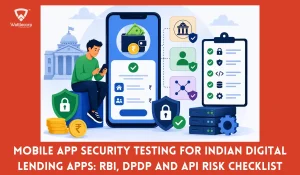 Mobile App Security Testing for Indian Digital Lending Apps RBI, DPDP and API Risk Checklist
Key Takeaways: Mobile app security testing forms an important part of meeting RBI cybersecurity expectations, secure application development practices, and periodic security assessment requirements for digital lending platforms. APIs in lending apps are constantly under attack. Broken object-level authorization, data leaking where it shouldn’t, weak token validation, and missing rate limiting, these aren’t edge cases, […]
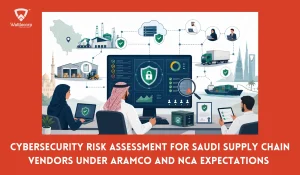 Cybersecurity Risk Assessment for Saudi Supply Chain Vendors Under Aramco and NCA Expectations
Key Takeaways: Cybersecurity risk assessment becomes a practical requirement for proving security maturity, with protecting vendor relationships, and moving forward in procurement processes with Aramco and critical infrastructure clients. Vendors will need to provide evidence of access review documentation, patch deployment, monitoring artifacts, technical assessment results and more that demonstrates the controls in place are […]
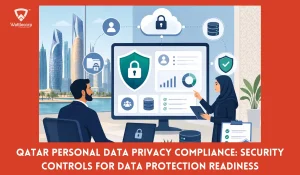 Qatar Personal Data Privacy Compliance: Security Controls for Data Protection Readiness
Key Takeaways: Qatar’s Personal Data Privacy Protection Law applies to organizations that process personal data within its scope, including many businesses handling personal data of individuals in Qatar. Non-compliance isn’t just risky; it can result in hefty fines, operational chaos, and serious damage to your company’s reputation. Personal data privacy compliance Qatar isn’t just about […]