


Wireless Network Security Assessment in the UAE: Is Your Enterprise WiFi Truly Guarding Your Assets?

Key Takeaways:
- Wireless attacks don’t require physical entry; a parked car or a nearby cafe is often close enough. Penetration testing identifies exactly how far your WiFi, Bluetooth, and IoT signals reach and who can pick them up from the street.
- A single rogue router or an outdated encryption setting can act as a bridge for an intruder. We demonstrate exactly how Evil Twin clones and de-authentication attacks work, proving whether your current defenses are actually stopping threats or just providing a false sense of security.
- The wireless penetration testing process moves from signal mapping to a clear remediation roadmap to ensure your setup meets local standards like NESA in UAE.
- Fixing technical flaws is only the first step. Leadership needs to know how those flaws impact the bottom line. By turning technical data into a clear risk report.
What Is Wireless Network Penetration Testing? A Guide to Shifting From Automated Scans to True Defense.
Wireless Network Penetration Testing is a formal security assessment, which is designed to evaluate the defensive posture of an organization’s wireless ecosystem. Unlike standard vulnerability scanning, this procedure involves active exploitation of the radio-frequency spectrum, including WiFi, Bluetooth, and IoT protocols.
Security analysts simulate real-world attack techniques to determine if encryption can be bypassed or if authentication can be defeated. To an enterprise located in the UAE, this is an objective examination of how a threat operator can get unauthorized access when physically near the office, like in a nearby location or via a nearby vehicle.
The ultimate goal of wireless network penetration testing is to find and patch technical vulnerabilities, which in turn makes the organization as a whole resistant to high-level cyber attacks.
The Hidden Exposure: Identifying Critical WiFi Vulnerabilities Within the Enterprise
Your WiFi signal coverage extends through walls, so your network is significantly larger than your office area. A rogue access point can be considered one of the greatest challenges of IT teams.
This is done when an unauthorized device such as a personal router is inserted in the network and this establishes a hidden unmonitored point of entry through which all the formal security rules are by-passed.

Additionally, relying on outdated encryption standards or having disorganized settings on modern WPA3 equipment can leave your digital doors wide open.
Many organizations also struggle with signal leakage, this is when your WiFi reach extends into public streets or parking lots, allowing hackers to attempt a breach from a safe distance without ever stepping inside your building.
Also Read : Network Security Testing: Understanding Types, Tools, and Techniques
Without consistent wifi security testing, these technical oversights remain hidden until a major data breach occurs. Identifying these vulnerabilities early is the only way to maintain a secure wireless network in a high-risk business environment.
Understanding the Ways People Break Into Wireless Networks
Hackers use different clever tricks to penetrate corporate systems. A common tactic is the Evil Twin attack, where an intruder sets up a fake WiFi signal with the same name as yours to trick employees into giving away their passwords.
They also use De-authentication hits to forcibly kick staff off the internet, catching their login data as the devices try to reconnect.
Some advanced threats even target the physical hardware or use man-in-the-middle interceptions to read private emails as they travel through the air.
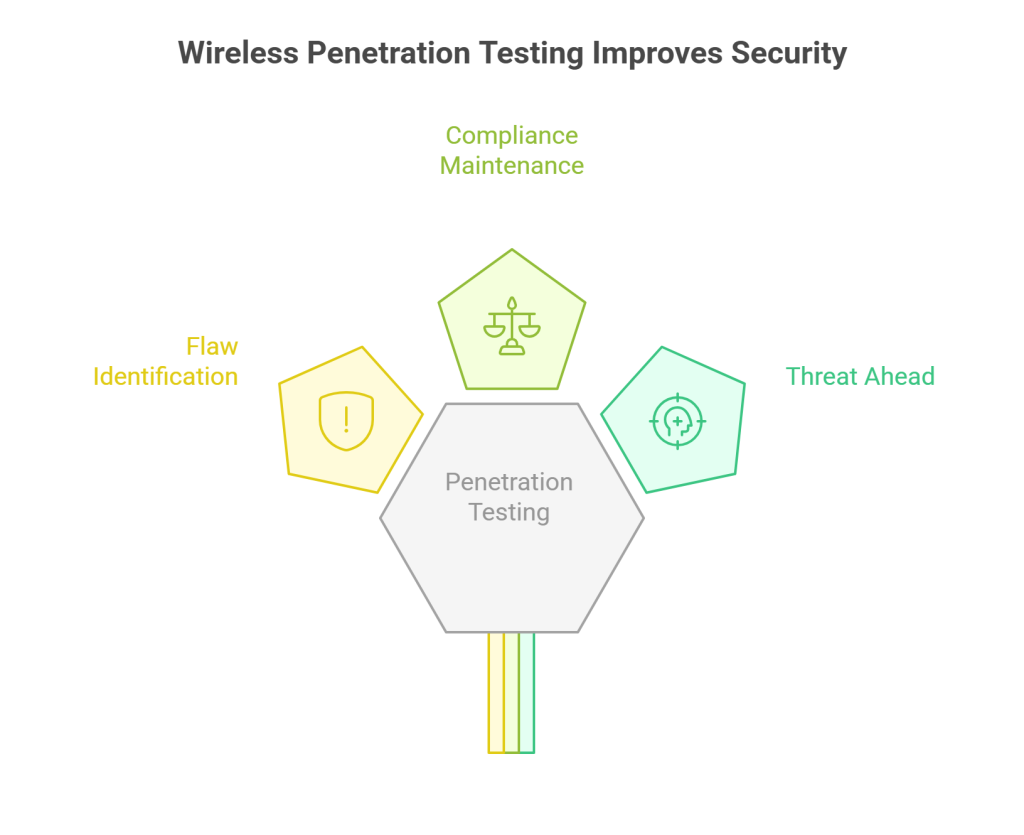
A primary objective of Wireless Network Penetration Testing is to mimic these exact moves. This proves that whether their current security tools are actually doing their job or just providing a false sense of safety.
Identifying these flaws through a wireless penetration test is the only way to stay ahead of modern, proximity-based threats.
There comes the importance of regular penetration testing of your wireless infrastructure to help maintain compliance with regulatory standards.
Testing supports frameworks such as ISO 27001, PCI DSS, and GDPR by demonstrating due diligence in securing personal data.
The Testing Framework: A Systematic Approach to Wireless Penetration Testing
Advanced wireless penetration testing has a well-defined systematic methodology in order to make sure that all the possible gaps are identified in a step by step manner.
- Scanning: Begins with mapping the entire wireless footprint, identifying all authorized access points and signal leakage across physical boundaries to establish the scope of attack.
- Research: Experts search the data to uncover vulnerabilities in the connection and authentication of your devices.
- Active Testing: The team attempts to successfully break into your wireless network infrastructure, using real world attack tactics, safely demonstrating how an attacker could compromise your network or steal data.
- Reporting: All identified vulnerabilities are consolidated into a structured report detailing technical findings, risk severity, exploitation paths, and actionable remediation guidance, enabling teams to address weaknesses efficiently and effectively.
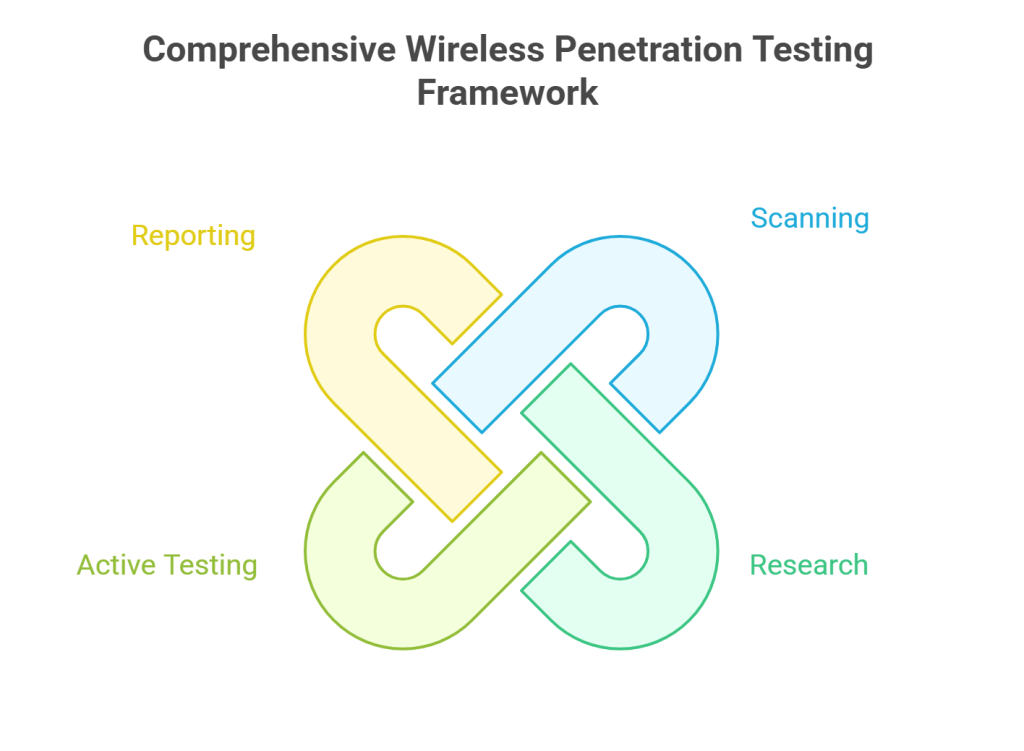
This structured approach ensures that your wifi network testing is helpful, professional and stays in line with global safety standards like NIST and the latest ISO rules.
Regulatory Readiness: Aligning with UAE Cybersecurity Mandates and Standards
The UAE government is more concerned about digital safety, and the rules are getting stricter every year for any business using wireless network security.
Laws like the National Cybersecurity Strategy and the UAE Data Protection Law require companies to use high-level protection for any system holding personal data, including your WiFi.
Also Read : How VAPT Helps Enhance Application Security Testing in CI/CD Pipelines for UAE Businesses
The NESA (SIA) or the Abu Dhabi ADSIC rules clearly state that you must run periodic checks to keep your data private and your systems stay up.
For banks or clinics, a regular wireless network vulnerability assessment is a legal requirement, not an optional test.
Keeping up with these local rules shows your partners that you are a reliable, law-abiding business that takes data privacy as seriously as they do.
A Guide to Due Diligence: Selecting the Right Security Experts in Dubai
When you are looking for a VAPT company in dubai, you need a partner that understands the local culture and the specific laws of the region.
A great provider doesn’t just hand you a computer-generated list of errors; they provide human-led wireless pentest services that look at your specific office layout and staff habits.
Evaluate whether the security team possesses industry-recognized credentials, including OSCP and CREST, along with demonstrated experience in assessing large-scale and complex network environments.
The testing will be done by a reliable company that will cooperate with your team to ensure that the process does not slow your internet or disrupt your working hours.
At Wattlecorp, we help your organizations leverage expert VAPT capabilities to transform security from a challenge into a strategic business advantage.

The most advantage of Wireless Network Penetration Testing is the peace of mind that comes from knowing you aren’t an easy target.
By finding and fixing gaps yourself, you can avoid the high costs and reputational damage by major data breach.
A professional wireless security assessment definitely helps enterprises to identify blind spots before attackers do. At Wattlecorp, with our deep expertise in cybersecurity penetration testing empowers businesses to stay ahead of threats.
The Wireless network penetration testing offers more than just safety; it often helps your IT team improve wireless network services by identifying messy settings that slow down your connection.
Running these checks on a regular schedule also builds a security-first culture among your staff, making them more likely to notice a suspicious device or connection.
Ultimately, consistent wifi security assessment keeps your business resilient and ready to grow, even as hackers develop new ways to attack.
Ready to secure your wireless network?
Contact Wattlecorp today for a customized security assessment.
Wireless Network Penetration Testing FAQs
1.What is wireless network penetration testing?
Wireless network penetration testing is a controlled, professional hack of your WiFi systems to find where the weaknesses are. Instead of waiting for a real attacker to find a way in, security experts find the holes first and show you exactly how to patch them up.
2.Why is WiFi security critical for enterprises in the UAE?
WiFi security is vital for UAE businesses because the country’s strong economy and rapid digital growth make it a common target for online attacks. A single network breach can cause serious legal trouble, heavy fines, and damage to your company’s reputation and client trust.
3.What types of wireless attacks are tested during WiFi VAPT?
We test for Evil Twin hotspots, rogue routers, password-cracking attempts and captive portal bypass attempts . We also check if your office WiFi signal is bleeding too far into the street and if your guest network is truly separated from your private company files.
4.How often should enterprises perform wireless penetration testing?
You should do it at least once a year. However, if you move offices, add a lot of new staff, or change your network hardware, you should run a test immediately to make sure no new gaps were accidentally created during the transition.
5.Is wireless penetration testing required for compliance in the UAE?
Yes. Major UAE security frameworks like NESA require regular testing of all network entry points. If you work in government, finance, or healthcare, showing proof of these tests is often mandatory to meet national data safety and audit standards.

 Mobile Application Penetration Testing for Qatar Government Digital Services: NCSA- Aligned Security Assurance
Key Takeaways: Mobile Application Penetration Testing Qatar must cover the app, device storage, APIs, authentication and third-party components. Qatar’s NCSA assurance environment combines the National Information Assurance (NIA) Standard, the National Information Security Compliance Framework (NISCF) and accredited security assessment services. OWASP MASVS defines mobile security controls, while MASTG supplies practical test methods for Android […]
 Qatar Data Protection Law: Implementing PDPPL Data Subject Rights Processes for Businesses
Key Takeaways: The Qatar Data Protection Law (Law No. 13 of 2016) for Personal Data Privacy Protection, grants individuals specific rights such as right to access, correct, erase, object, withdraw consent, and right to be notified of processing or inaccurate disclosure. Beyond having a privacy policy, businesses or controllers, under Article 11 of Personal Data […]
 AI Governance for Indian Enterprises: Building Internal Controls Before Key DPDP Obligations Take Effect
Key Takeaways: The DPDP Act does not contain AI-specific provisions. Its requirements, however, apply in situations when an AI system processes digital personal data within its territorial and material scope. India is working on building a broader governance framework around safety, accountability, transparency and trust via programs like the IndiaAI Mission. Indian organizations should inventory […]
 Cloud Security Audit for UAE Government Cloud Migration: NCAP and Security Requirements
Key Takeaways: A cloud security audit UAE helps government entities identify security, governance, configuration, access, data-protection and resilience gaps, before and after shifting critical workloads to the cloud. UAE National Cloud Security Policy has defined cloud governance, data security, data sovereignty, IAM, incident management, resilience, portability and cloud operations requirements. The National Cyber Accreditation Program […]
 Data Privacy Consulting UAE – Building a PDPL-Compliant Data Governance Program
Key Takeaways: PDPL compliance requires ongoing operational governance that goes beyond policies to demonstrate how personal data is collected, used, protected, transferred, retained, and deleted. Data mapping helps businesses move from reactive compliance to proactive risk management by establishing a comprehensive inventory of the data ecosystem, helping build a mature data privacy and governance program. […]
 Saudi Arabia’s Critical Systems Controls: What CSP-Linked Enterprises Must Comply With in 2026
Key Takeaways: The Critical Systems Cybersecurity Controls (CSCC) are more applicable to critical systems than to all IT assets owned or operated by an organization. To be in full compliance or to remain in full compliance with CSCC, organizations must maintain continuous adherence to NCA ECC. CSCC has 32 core controls and 73 sub-controls across […]