
Key Takeaways:
- Understanding what data minimization and purpose limitation mean under India’s new Digital Personal Data Protection Act.
- Insights on why businesses must collect only necessary data.
- Detailed guidance on what organisations must do to stay compliant by India’s updated digital personal data protection act.
- Know about transparent consent, storage limits, and purpose-led data collection, and how it builds user trust.
- See how expert guidance from data privacy professionals helps organizations use personal data safely in responsible ways.
What Is Data Minimization?
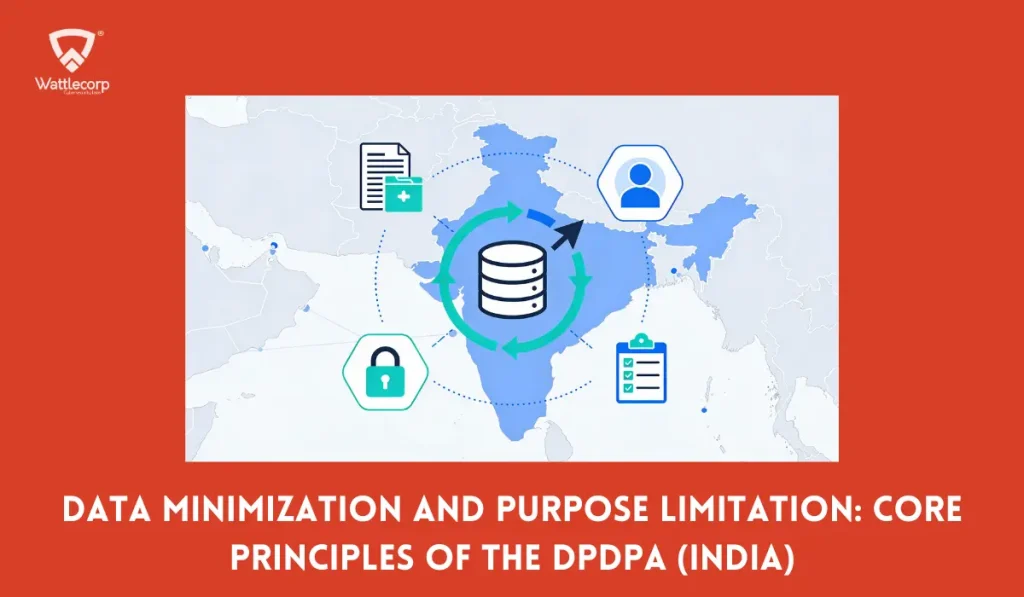
Data minimization is the principle that organizations must collect, store, and process only the personal data that is necessary and limited to the purpose for a specific, legitimate concern. According to the latest news from Bar and Bench, the Ministry of Electronics and Information Technology of India finalized the Digital Personal Data Protection Rules on November 13, 2025, with a deadline period of 12-18 months.
Based on the updated Digital Personal Data Protection Rule of India 2025, Section 3(b) and 3(c) propose that all data principals must be informed about what is collected, and they must be provided an easy option to withdraw the consent.
What Is Purpose Limitation?
Purpose limitation requires organizations to collect personal data only for clear, specific, and lawful purposes. The Indian government’s Digital Personal Data Protection Act defines that any data collected from the data principal must be strictly used for the mentioned purposes. Moreover, when there is a secondary need, such as use, sharing, profiling, or repurposing, the company must require fresh consent from the subject.
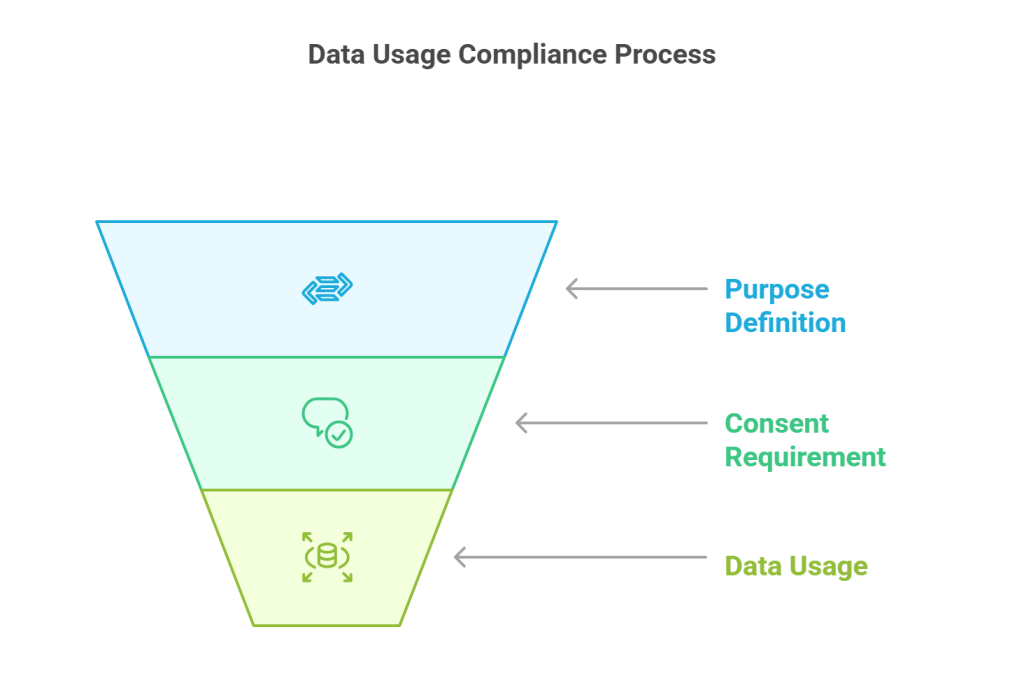
For instance, if a business collects email IDs for invoicing, they cannot use them for marketing without permission from the respective data owner.
Why These Principles Matter for Indian Businesses?
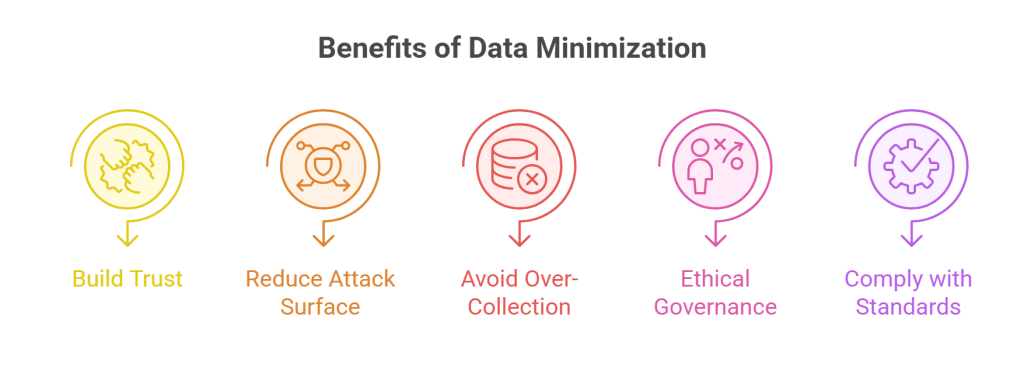
Data minimization and purpose limitation are more than just legal obligations ruled out by India’s Digital Personal Data Protection Act; rather, they are essential elements for a responsible business. Following them helps organizations:
- Build trust and transparency with customers
- Reduce the attack surface, limiting the impact of a potential breach
- Avoid over-collection of data that increases risk in abiding by compliance, storage, and security costs
- Help follow strong ethical data governance and reduce reputational risks
- Comply with the DPDP Rules and global standards such as GDPR and CCPA
With the rise of digital services in India, there is a need for strict enforcement of data collection and usage. Here, the updated rules announced by the MeitY lay the foundation for responsible data handling.
The Times of India reports that, based on the recent release of the Digital Personal Data Protection Act, companies that are responsible for serious breaches can face penalties of up to 250 crores. The aftermath of breaches can have a huge impact on businesses, and this implies the need to abide by data protection laws.
Things to Focus to Keep Your Business Digital Personal Data Protection Act-Compliant
Source Only the Needed Data
A DPDPA-compliant organisation starts with limiting unnecessary collection of data. Businesses that are clearly aware review every form, app, or process and verify each field and clarify if they are essential for the service being delivered. If not, it should not be collected. This reduces risks, keeps systems cleaner, and gives users a sense of security while sharing their information.
Define the Reason for Collecting Data
Before requesting any personal data, businesses need to mention the purpose in simple language for user understanding. This purpose must be lawful and specific, and must be informed to the data subjects before collecting them. Once collected, the data must never be used for a different reason. The Digital Personal Data Protection Act of India states that if there is any further need, the business must obtain explicit permission again from the user.
Also Read : Preparing for Data Protection Audits: Leveraging VAPT to Ensure Compliance with DPDPA
Follow Transparent Consent Policy
According to the Data Protection Act, consent must be free of choice. Every data sourced should be specific, informed, and very clear to the user. Businesses must design consent prompts that clearly explain what data they want and why. Users should also have easy options to withdraw consent whenever they need. So, when businesses maintain clear, accessible consent records, it is beneficial when doing audit checks.
Avoid Data Storage Beyond the Needed Duration
Data must be kept only for the duration required to fulfill the original purpose. Organizations should be watchful of the retention timelines, automate deletion processes, and regularly review the data in use and remove those that are no longer needed, strictly following the Digital Personal Data Protection Act. This avoids unnecessary storage costs and reduces the impact of possible breaches that may appear.
Strengthen Security
The DPDPA framework rules suggest that businesses consider appropriate technical and organizational measures to protect personal data. Processes like encryption, access controls, monitoring, and regularly checking security strength should be enabled. Additionally, your business must have a strong incident response plan so that if there is any case of breach, the organization can detect, contain, and report it quickly as required by the Digital Personal Data Protection Act.
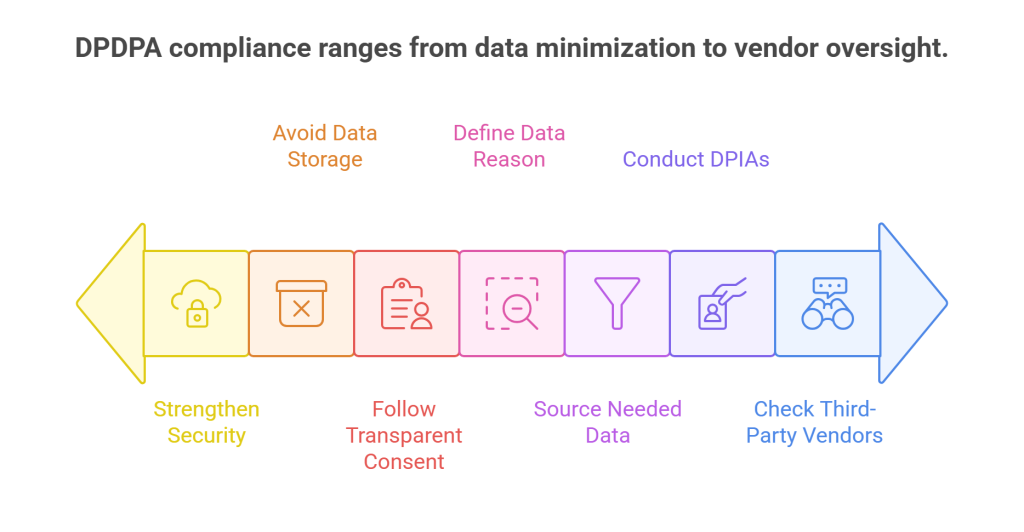
Conduct Data Protection Impact Assessments (DPIAs) When Needed
DPIAs help businesses identify the privacy risks by analysing the vulnerabilities. By examining how data is collected, used, and stored, organisations can determine whether processing is necessary and proportionate. This promotes privacy by design and ensures that risks are addressed before systems go live.
Check if Third-Party Vendors Follow the Rules
Businesses are responsible even for the data handled by their partners, processors, or vendors. This makes it essential to select vendors carefully and must produce strong data-protection clauses in contracts, while regularly doing periodic audits. By monitoring vendor compliance, businesses can protect operational integrity and customer trust.
Practices to Follow for a Digital Personal Data Protection Act-Compliant Organisation
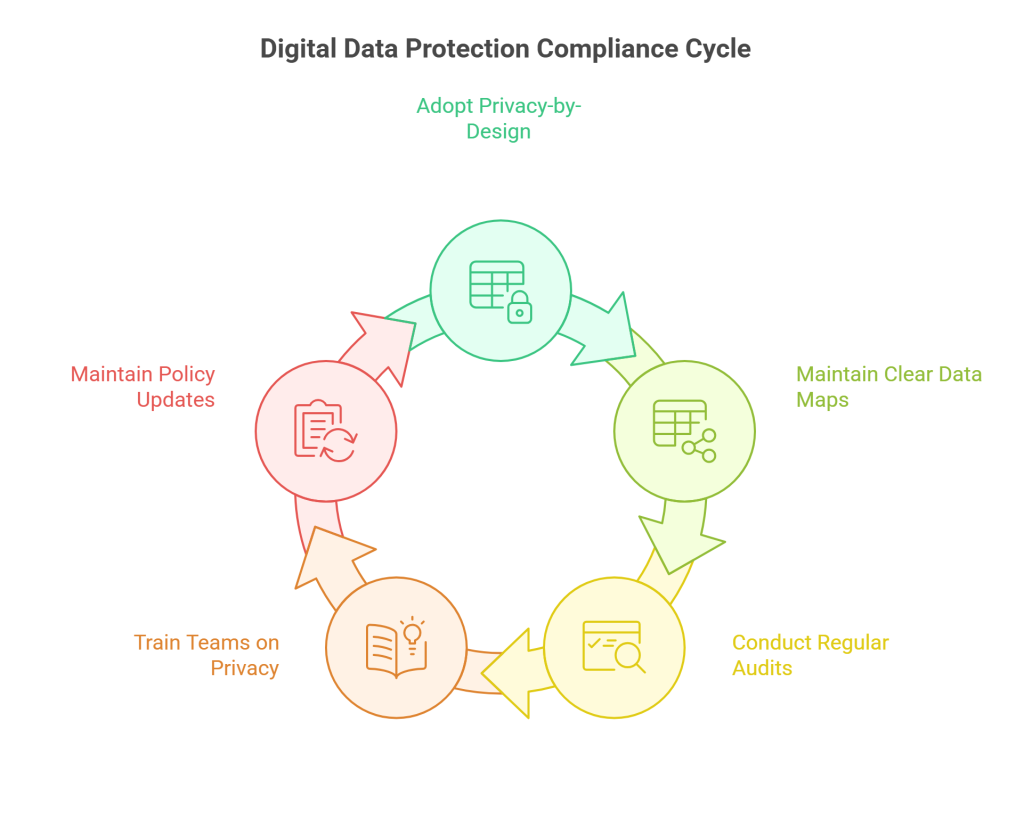
Adopt Privacy-by-Design
Privacy must be integrated at the early stage of designing or the planning stage of a new product or process to keep up with compliance. When you follow such an approach, it can reduce huge risks associated and avoid costly redesigns or violations.
Maintain Clear Data Maps
Your business must have a detailed understanding of the data processes, including what data is collected, where it resides, who accesses it, and how long it is stored with you. When businesses maintain a clear data map, it simplifies compliance assessments and helps the organization quickly respond to access or deletion requests from users.
Also Read : Navigating Cross-Border Data Transfers Under India’s DPDPA
Conduct Regular Audits
Performing periodic audits helps identify outdated data, incorrect access permissions, or unmonitored systems. Running early reviews consistently at regular intervals can help your business correct compliance gaps before they turn into risks while fully adhering to the Digital Personal Data Protection Act. These audits help in maintaining robust data hygiene practices throughout the year.
Train Teams on Privacy Awareness
Employees interact with personal data daily. So they must be educated about the data practices and the risk mitigation processes. Regular training keeps them informed about the security practices, consent handling, data access rules, and breach response protocols. When employees are aware of the privacy concern, the risk of accidental violations reduces.
Maintain Policy Updates
Users must be given clear directions to understand what data is collected, how it is used, and what rights they have regarding enabling consent and removal. There is a recent update on the Digital Personal Data Protection Act, and it is now the Digital Data Protection Rules of India; every business operating in the country must abide by it.
This implies that every business active digitally and accessing data must adapt to regulatory changes whenever there is a government update.
How Wattlecorp Supports Businesses in Following the Digital Personal Data Protection Act
Every modern organization that is operating digitally, like in technology, healthcare, manufacturing, retail, or e-commerce, sources personal data online in some form. When a huge amount of data is processed, there are also associated risks.
To keep up with the updated DPDP Rules, there must be clear oversight from trained professionals. Many businesses struggle to monitor evolving requirements or implement privacy frameworks on their own, as they lack in-house experts. This is where there is a need for experienced data privacy experts.
Wattlecorp brings years of proven success in guiding organizations through compliance journeys. We help in establishing data-secure organizations with the assistance of our qualified data privacy experts in India. Our team of certified data privacy and cybersecurity professionals provides structured support to help you build a Digital Personal Data Protection Act-aligned business environment where all data is protected.
Digital Personal Data Protection Act FAQs
1.How does data minimisation apply under the DPDPA?
Under the Digital Personal Data Protection Act, organisations must collect only the personal data that is particularly necessary to deliver a service or fulfill a specific purpose. Here, businesses has no rights to collect extra, unrelated, or “nice-to-have” information. The primary purpose of this is to keep user data safe from risk and to enable lawful handling of personal information.
2.What does purpose limitation mean in the context of Indian privacy law?
Purpose limitation means a business must collect personal data only for a clear and specific purpose. Businesses must inform the user about the stated purpose and must use the data only for that purpose. If the organisation later wants to use it for something else, they must get new consent from the data subjects.