

How to Build a Cybersecurity Culture? Workforce Engagement Tips
Integration with new software, AI, and IoT devices demands higher security now more than ever. Since organizations depend heavily on such technologies, they are also very prone to breaches, phishing, and other cyber threats. Thus, building a cyber security culture is fundamental to all the cybersecurity measures a company can take.
The Necessity of Cyber Security Culture
Companies opt for tools and software that provide antimalware features for computer and company-owned network devices to protect sensitive data from breaching. All these tools and devices are operated by members of an organization The first step to cyber security is to nurture a security-conscious environment.
People who operate the company can be tricked into accepting illegitimate websites through phishing and other means. Employees are not deliberately opting for threats, due to a lack of cyber security awareness and knowledge on how to securely handle data, employees often fall for the threats. To mitigate such risks, organizations need to invest in promoting a cyber security culture, Apart from security policies, proper cyber security training, ongoing tests, and cultivating cyber security consciousness altogether can build a strong human firewall.
Benefits of Having a Cybersecurity Culture
A strong cyber security culture ensures that the belief system and attitude around the work environment continuously enforce cyber security awareness.

- In remote working, companies often encourage BYOD policies, which can make company resources and data susceptible to breaches. So employees have to ensure their devices and networks are secure. With cyber security awareness programs, organizations can educate their employees regarding the necessity of cybersecurity, the measures to secure their devices and
- The investment in developing a security-conscious workspace is much lower than the consequences of cyber attacks due to the lack of security awareness.
- Data breaches, phishing scams, and other cyber attacks can significantly impact the reputation of the company
- A cyber security culture can be used as a marketing strategy since most customers would opt for a secure platform, and a cybersecurity-conscious environment can easily gain customers’ trust.
- While incorporating evolving technologies also comes with more cyber threats, the IT team will have to monitor these threats continuously. Adding anti-malware software and firewalls isn’t enough, implementing a strong cyber security culture can help build a human firewall against the growing security risks.
How do you Instill a Strong Cybersecurity Culture in The Workplace?
Non-security staff might not be aware of the implications of fractured cyber security, therefore, teaching employees the importance of cyber security continuously becomes a burden to IT and cyber security teams. Cybersecurity culture is not just training but the continuous process of cultivating values of cybersecurity with various measures.
The major tactics are as follows:
1. Implement engaging and interactive cyber security awareness training
As cyberattacks get more sophisticated, employees should be made aware of the consequences of an attack and should be able to detect the pitfalls. A cross-departmental interactive training with simulations, tests, and tutorials regarding phishing scams and other potential cyber attacks are ways to build up a human shield against cyber attacks. Instead of long-lasting lectures engaging sections with real-life examples of cyber crimes that can capture the audience’s attention, the goal is to encourage employees to build regular cyber security hygiene.
2. Standard security policies
To protect company resources and data, limit accessibility, and enforce strict security policies to encourage accountability among employees. Security policies and procedures for each device and company data that adhere to their usage as well as their security. Implement standard password policies, and 2 or more factor authentication and ensure that all employees follow the procedures
3. Positive reinforcement of security behaviors
At times, strictly enforcing policies or penalizing them for their mistakes can be counterproductive. Instead, reinforce a more positive outlook where efforts for completing training and following cyber security hygiene are rewarded. This can promote a culture of both responsibility and accountability.
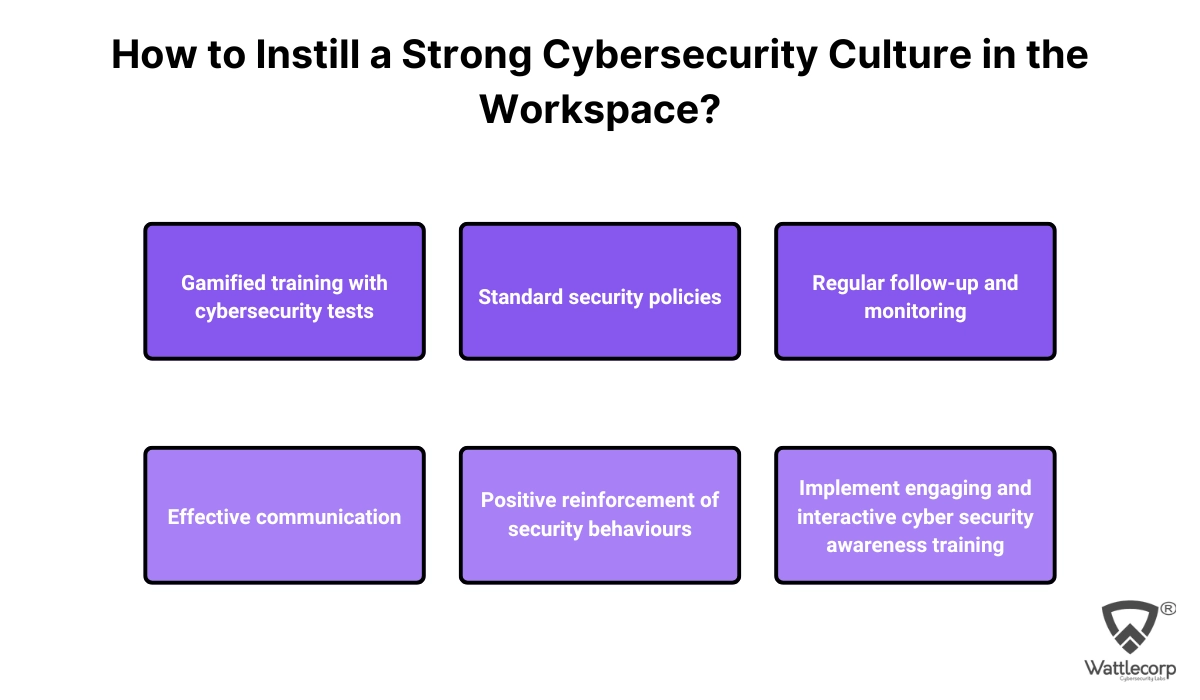
4. Regular follow-up and monitoring
Successful completion of training should be followed by regular assessment tests and evaluating the cyber security changes of the company along with individual changes. A stronger cyber security culture is built by ensuring that employees follow the security guidelines post-training.
5. Effective communication
To improve the cyber-security consciousness among employees, there should be a transparent atmosphere where everyone feels comfortable giving feedback, raising queries, and reporting their faults. Create channels for employees to communicate directly with the security team and ensure to respond positively
6. Gamified training with cybersecurity tests
Engage employees in role-playing games where they detect and solve cyber-security issues as per the guidelines. Conducting cyber security drills and aiding practices for data breach and phishing simulations. Incorporate AI tools as part of regular practice to reduce the burden of regulating too much data.
How do Divide the Responsibility of Cybersecurity Culture?
For an effective cyber security culture, individuals at all levels of the organization should have shared accountability. In most companies, responsibilities are split among senior executive members and an average employee.

a. Leadership and management level
From setting the cybersecurity policy of the company to resource allocation, they take part in each process. The CISO team often leads the security training, even then, setting a culture of values and attitude that is focused on cyber security is the responsibility of the management, including the board of directors.
b. Team level
Since cyber security threatens the entire organization, encourage cross-departmental interactions so that employees can get different perspectives about cyber security risks. The HR, IT, or cyber security teams are also responsible for conducting cyber security training, ensuring regular follow-up for post-training, and effectively communicating with employees to clarify their queries.
c. Employee level
The entire focus of enforcing cyber security hygiene is to practice it on an individual level. Individuals should make an effort to understand the risk of cyber attacks as much effort as they put into work. This can be helpful for the company to strengthen its security poster, and this knowledge can also come in handy for personal use.
The Challenges in Nurturing Cyber Security Culture
Building a cyber security culture entails changing the current habits within individuals and the entire organization to a more security-oriented one. This is often met with some resistance, The factors that challenge The nurturing cyber security culture are as follows.
- Lack of employers follows: even when security awareness training is mandatory, they are often not practising in many organizations. As they are crucial for an IT-based company when they take in an employee who is not from an IT background, often such employees would not receive any prior cyber security training, making it entertaining, and difficult for the organization to proceed through.
- Lack of efficiency: People often make careless mistakes that can be easily solved with the help of IT experts, and a lack of effective communication between departments can escalate even a minor security crack. Lack of cross-departmental interaction, unwelcoming of criticism or feedback and the inertia to put up with suggested changes can push people back to communicate with the organization.
- Lack of awareness: Employees can be unaware of the repercussions of their mistakes when it comes to cyber security, Training can solve this to an extent. But every time the company switches to new software or makes use of AI tools that can respond to cyber security threats effectively, employees need to be prepared.
- Difficulty in distributing responsibility: As cyber security threats affect the entire organization, faults should be shared equally. Often, the IT department is burdened with the responsibility of ensuring cyber security, and splitting the responsibility between departments is a good solution. However, this is often met with resistance because individuals can think of it as an added responsibility.
Building a credible cyber security workspace not only strengthens your cyber security but also improves cyber consciousness among employees, resulting in a better brand image. Even with advanced cyber security tools, the threat of an attack will always loom, Creating a habit of a security-conscious approach and making it part of daily work life can significantly reduce exposure to security risks.
Cybersecurity Culture FAQs
Ans: The cybersecurity culture within an organization ensures that all the members are well aware of the cyber security threats, eventually creating a secure human firewall for the company. Since employees often access company devices and resources, a strong cyber security culture can protect sensitive data from breaches. As a company adapts to advanced technology, new cyber threats also emerge, Such cybersecurity threats, if not addressed properly, can be colossal for the company.
Ans: Ways to encourage cybersecurity hygiene among employees
Company-wide cybersecurity training and awareness to make them understand the consequences of cyber threats
Encourage employees with incentives for good cyber security hygiene
Gamified training
Regular security drills
Effective communication by conducting feedback and evaluation regarding cybersecurity
Ans: A strong cyber security culture starts by following basic security steps, including a strong password policy and 2-factor authentication for limiting access to company data. Adopting engaging and interactive cyber security training, continuously monitoring post-training behaviour and using an open-to-feedback approach for effective communication are some of the key elements of a strong cyber security culture.

 Third-Party Vendor Security Risk Assessment Under DPDP: A Guide for Indian Enterprises
Key Takeaways: Third-party vendor risk assessment with DPDP practices helps Indian enterprises to verify that external partners handle personal data with adequate safeguards. The Digital Personal Data Protection Act holds data fiduciaries accountable for vendor conduct, which makes due diligence a legal and operational necessity. A structured vendor security questionnaire, covering encryption, access control, and […]
 Virtual CISO Services for UAE Free Zone Startups: Affordable Security Leadership for Growing Companies
Key Takeaways: Most startups already hold sensitive data such as customer info, source code, financials, long before they feel big enough to take security seriously, and that’s exactly when the risk starts. A virtual CISO gets you someone who’s done this before, setting up strategy and guiding compliance, without the cost of putting a full-time […]
 SOC as a Service for Indian BFSI and FinTech Companies: 24/7 Monitoring for CERT-In Readiness
Key Takeaways: SOC as a Service for BFSI and FinTech India gives banks, NBFCs, insurers and digital lenders continuous security visibility without the cost and hiring effort of building an in-house operations centre. CERT-In directions require regulated entities to report qualifying cyber incidents within six hours of detection, and implementing SOC for BFSI and FinTech […]
 SOC as a Service in India: How It Works, Pricing, and Why Businesses Need It
Key Takeaways: SOC as a Service helps Indian businesses to get 24×7 security monitoring without huge cost and complexity of building a full in-house security operations center. A managed SOC check and analyse beyond basic log monitoring, which combining SIEM, threat intelligence, analyst-led alert triage, incident escalation, reporting, and security response support. SOC as a […]
 Mobile App Security Testing for Indian Digital Lending Apps RBI, DPDP and API Risk Checklist
Key Takeaways: Mobile app security testing forms an important part of meeting RBI cybersecurity expectations, secure application development practices, and periodic security assessment requirements for digital lending platforms. APIs in lending apps are constantly under attack. Broken object-level authorization, data leaking where it shouldn’t, weak token validation, and missing rate limiting, these aren’t edge cases, […]
 Cybersecurity Risk Assessment for Saudi Supply Chain Vendors Under Aramco and NCA Expectations
Key Takeaways: Cybersecurity risk assessment becomes a practical requirement for proving security maturity, with protecting vendor relationships, and moving forward in procurement processes with Aramco and critical infrastructure clients. Vendors will need to provide evidence of access review documentation, patch deployment, monitoring artifacts, technical assessment results and more that demonstrates the controls in place are […]