


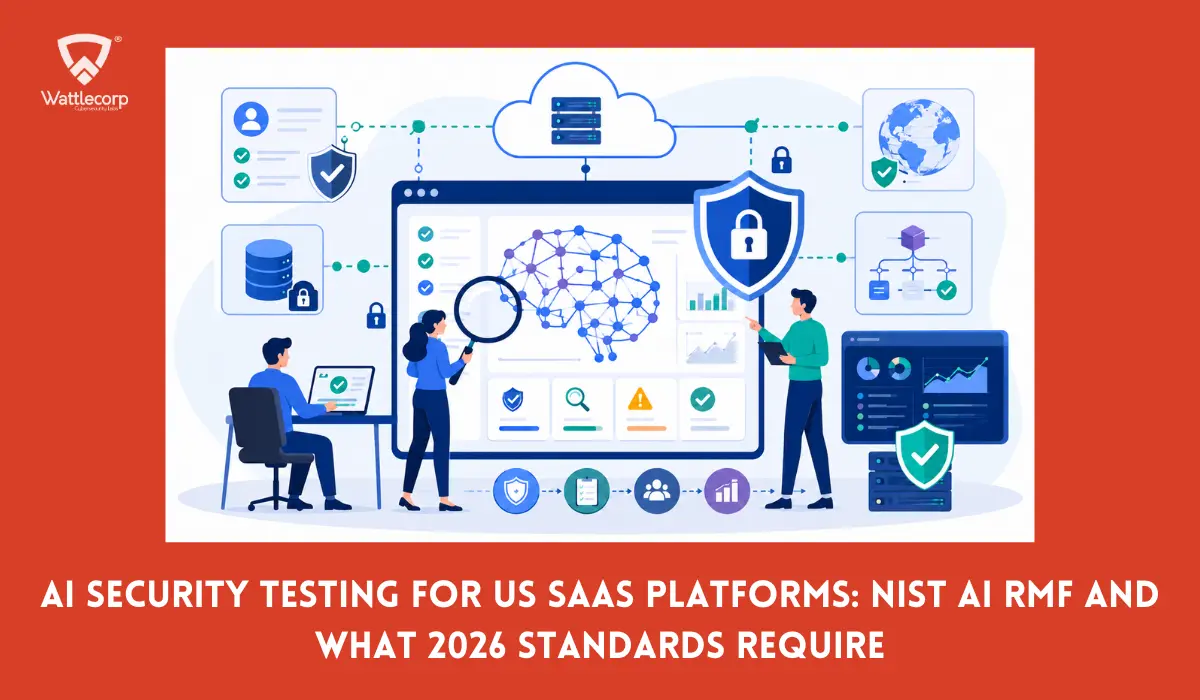
AI Security Testing for US SaaS Platforms: NIST AI RMF and What 2026 Standards Require
Key Takeaways:
- AI security testing for SaaS platforms isn’t just a technical upgrade from traditional app security. It’s a completely different job. You’re not running a scan on code, you’re stress-testing a model to see how it breaks when someone is actively trying to make it fail.
- NIST AI RMF isn’t law yet, but your next enterprise client probably expects it anyway. Procurement teams, cyber insurers, and federal buyers are already treating it as a reference point.
- Prompt injection is already a practical concern for LLM-integrated SaaS applications, while data poisoning, model inversion, and adversarial manipulation are credible risks depending on model access, training pipelines, data sensitivity, and deployment context.
- If you’re a SaaS startup, figuring out AI governance later is an expensive plan. Building the right structures early costs far less than rebuilding them under pressure during a Series B audit, when enterprise clients are asking hard questions and the clock is ticking.
- Your internal team can only see so far. Enterprise due diligence, cyber insurance reviews, and regulators increasingly want third-party validation, not a self-assessment. Independent AI security testing and compliance consulting aren’t optional extras anymore; they’re part of how trust gets built.
Why AI Security Testing for US SaaS Platforms Must Align with NIST AI RMF
Most SaaS companies aren’t actually running ai security testing for saas platforms the way they think they are. They’re running routine application scans, scheduling a penetration test every quarter or two, and checking that box.
Testing an AI system means something different. You’re not just hunting for exposed ports or outdated libraries.
You’re evaluating how a model behaves when someone is actively trying to break it, whether its training data has been quietly tampered with, and whether its outputs could be reverse-engineered to surface sensitive information about your users.
That’s a different problem, and it demands a different set of tools, skills, and mindset.
In 2026, that distinction has finally landed with the people who matter, enterprise procurement teams, regulators, and cyber insurers.
They’re not asking whether your SaaS platform has a security program anymore. They want documented AI-specific controls.
In many AI governance and vendor risk conversations, the NIST AI Risk Management Framework is becoming one of the most recognized reference points.
For US SaaS companies, understanding what that framework actually requires and how to act on it where serious security work begins.
What the NIST AI Risk Management Framework Actually Is
There’s real confusion around the NIST AI RMF framework, so let’s clear it up quickly.
The NIST AI risk management framework is a voluntary guidance document from the National Institute of Standards and Technology.
NIST AI RMF is not a binding regulation, so it does not carry direct penalties for non-compliance or mandate specific technical controls.
What it does is give organizations a structured, practical way to think about AI risk across the entire system lifecycle.
The framework runs on four core functions: Govern, Map, Measure, and Manage. These aren’t sequential steps you complete once and move on from.
For top SaaS companies in the US, this translates into having genuine answers to questions that compliance teams are now asking routinely:
Who owns AI risk in your organization?
Which and what testing ran before the last model update shipped?
What’s your incident response playbook when a model behaves unexpectedly in production?
The NIST AI RMF also works well alongside NIST SP 800-53, which provides broader security and privacy controls for information systems and organizations.
Running both together gives SaaS platforms a far more complete picture and that pairing is increasingly the foundation of credible ai security testing for SaaS platforms in the enterprise space.
Why SaaS Platforms Need a New Security Strategy for AI Risks in 2026
Here’s something worth understanding before we get into solutions: the threat landscape for AI in SaaS isn’t theoretical anymore.
Prompt injection, data poisoning, model inversion, and adversarial input manipulation are no longer only academic concerns. Some are already practical in real-world AI systems, while others are credible risks depending on model access, training pipelines, data sensitivity, and deployment context.
AI security testing for saas platforms operates on a completely different logic than traditional software security testing.
Traditional security scanners can detect many known software, dependency, configuration, and application-layer issues, but they cannot fully assess whether an AI model can be manipulated through prompts, adversarial inputs, or unsafe tool use. It cannot tell you whether your language model will comply with a carefully crafted prompt that completely bypasses your system instructions.
Also Read : SaaS Risk Assessment: Unveiling Key Security Blind Spots Neglected By Providers
For top SaaS companies in the US, especially those operating in healthcare, fintech, or legal tech, AI security threats in SaaS carry real liability weight.
A meaningful AI-related breach doesn’t just trigger a technical incident response. It triggers regulatory scrutiny, customer churn, reputational damage, and in some sectors, direct legal exposure.
Proactive AI security testing for SaaS platforms isn’t just good practice anymore; it is a risk management decision with clear financial implications to secure AI systems.
The surge in demand for AI security testing services in the USA reflects exactly this shift. Companies that recognized it early are significantly better positioned heading into the tightening compliance environment of 2026.
How NIST AI RMF Compliance Actually Helps SaaS Companies
NIST AI RMF alignment is not a legal requirement today, but ignoring it can become a business risk when enterprise buyers ask for evidence of AI governance, testing, and risk ownership.
For SaaS teams, adopting the framework delivers something harder to quantify but genuinely valuable. Moreover, a shared language for AI risk conversations across the technical and non-technical stakeholders. Engineering, product, legal, and compliance often talk past each other when AI risk comes up.
NIST AI cybersecurity for SaaS startups deserves specific attention here. Early-stage companies building AI-native products almost universally defer governance work in favor of shipping speed.
That’s understandable. But the Govern function of the NIST AI RMF is exactly what prevents painful retrofitting at Series B, when your first serious enterprise customer sends over a detailed security questionnaire and expects real answers.
Companies that build governance structures early, even lightweight ones pass that scrutiny far more smoothly.
What is AI risk assessment in cybersecurity? In the SaaS context, it means a systematic, ongoing evaluation of how each AI component in your product could fail, be exploited, or cause unintended harm and whether the controls you have in place are actually adequate.
It’s not a one-time audit. It’s the operational backbone of any mature ai security testing for saas platforms program.
The Key Threats You Actually Need to Be Testing Against
You can’t build a serious ai security testing for saas platforms program without knowing what you’re testing for. In 2026, the major AI security threats in SaaS environments break down like this:
- Data Poisoning – Attackers manipulate training data to introduce hidden behaviors or degrade model accuracy in targeted ways. It’s particularly dangerous for US SaaS platforms that train models on user-generated content or third-party data streams, where input quality is harder to control and validate.
- Prompt Injection – In LLM-integrated SaaS applications, attacker-crafted inputs can override system prompts, cause the model to reveal sensitive information, or trigger unintended actions. This is one of the most important LLM application risks and is still underrepresented in many standard SaaS testing protocols.
Also Read : Key Cybersecurity Threats Addressed By VAPT In 2025
- Model Inversion and Inference Attacks – By repeatedly querying a model and analyzing outputs, attackers may infer sensitive attributes, recover memorized data fragments, or learn information about training records under certain conditions.
- Adversarial Examples – Inputs designed to fool classification models into making wrong decisions. For platforms using AI in fraud detection, content moderation, or identity verification, a wrong decision isn’t just a technical error, it has downstream consequences for real people.
- Third-Party AI Supply Chain Risk – Most US SaaS platforms don’t build AI from scratch. They rely on external APIs, pretrained models, and open-source components. The security posture of those dependencies directly affects yours, and in-house testing won’t catch what’s introduced upstream. Comprehensive ai security testing for saas platforms has to include the supply chain.
What 2026 Enterprise and Regulatory Expectations Are Moving Toward
The NIST AI RMF remains voluntary at the federal level, but it is increasingly used as a reference point in enterprise AI governance, vendor risk reviews, and AI assurance discussions.
In practice, ai security testing for saas platforms compliance in 2026 means being able to demonstrate:
- Documented AI governance policies with clear ownership, not just a policy that exists, but one with a named accountable party.
- Evidence of recurring AI risk assessment for SaaS platforms, not a single audit from 18 months ago.
- Alignment with the NIST AI RMF or a recognized comparable framework.
- Written incident response procedures that specifically address AI-related failure scenarios.
- Independent validation or third-party AI security testing where enterprise buyers, insurers, or internal risk teams require external assurance.
The gap for companies that haven’t started this work is real but it’s closeable. The NIST AI framework is designed to be incremental. Starting with Govern and Map gives you a credible baseline to build from, and the act of mapping your AI systems almost always surfaces risks that weren’t on anyone’s radar before.
Build AI Security Before Buyers and Regulators Demand It
Most US SaaS platforms are still playing catch-up on ai security testing for saas platforms and 2026 isn’t going to wait for anyone to finish catching up. The regulatory pressure is real, the threat patterns are documented, and enterprise buyers are already asking questions your team needs answers to.
Wattlecorp works directly with US SaaS companies navigating exactly this from NIST AI RMF alignment to building security programs that hold up under real scrutiny, not just on paper.
If your platform runs on AI and serves US customers, the gap between we have security coverage and we have the right kind of security coverage is worth closing now, before a customer audit or a breach forces the conversation.
For US SaaS teams ready to take AI security testing for Saas platforms seriously, Our SaaS Cybersecurity services are built around the specific compliance, risk, and AI security challenges US platforms face right now.
Whether you’re just getting started or preparing for enterprise-level due diligence, WattleCorp brings the depth and focus your platform needs to get there.
AI Security Testing for SaaS Platforms FAQs
1. What is the NIST AI RMF and why is it important for SaaS platforms?
2. How do US SaaS platforms ensure AI security compliance?
3. What are the best practices for AI security testing in SaaS platforms?
4. How can SaaS companies use NIST AI RMF for risk management?
5. What role does AI play in enhancing the security of SaaS platforms?

 DevSecOps for Indian Government: Meeting CERT-In Audit Requirements
Key Takeaways: CERT-In’s guidelines for application security advise integrating security throughout the Software Development Life Cycle (SDLC) than relying only on post-development audits. DevSecOps helps streamline CERT-In compliance India by moving security from a last-mile bottleneck to an automated, continuous process within the SDLC. Supporting CERT-In-aligned application security involves building a complete security lifecycle that […]
 DIFC AI and Automated Processing Regulation: Full Enforcement Guide for Dubai Financial Firms
Key Takeaways: Regulation 10 of the DIFC Data Protection Regulations applies to any DIFC entity deploying an automated system that processes personal data, including AI tools bought off the shelf from a vendor. The regulation splits responsibility between two defined roles, deployer and operator, and most financial firms are deployers even when they did not […]
 Black Box Penetration Testing for UAE Critical National Infrastructure: NCAP Pre-Accreditation Testing
Key Takeaways: Black box penetration testing examines critical systems from the perspective of an external attacker, who has minimal prior knowledge of the internal environment other than relying primarily on publicly available information and approved testing scope. It helps find shadow assets, exposed services, weak authentication, cloud misconfigurations, and vulnerable third-party access paths. Testing supports […]
 Cyber Security Strategic Consulting for UAE Boards: Aligning Security Investment with the NCSS 2025–2031
Key Takeaways: The Cyber Security Strategic Consulting UAE programmes help organizations align their cybersecurity roadmaps with the five NCSS pillars, namely governance, protection, innovation, establishing and building, and partnership. Boards should connect cybersecurity spending to material business risks, critical services, regulatory duties, and measurable resilience outcomes. Cyber security strategic consulting UAE programmes translate national direction […]
 Mobile Application Penetration Testing for Qatar Government Digital Services: NCSA- Aligned Security Assurance
Key Takeaways: Mobile Application Penetration Testing Qatar must cover the app, device storage, APIs, authentication and third-party components. Qatar’s NCSA assurance environment combines the National Information Assurance (NIA) Standard, the National Information Security Compliance Framework (NISCF) and accredited security assessment services. OWASP MASVS defines mobile security controls, while MASTG supplies practical test methods for Android […]
 Qatar Data Protection Law: Implementing PDPPL Data Subject Rights Processes for Businesses
Key Takeaways: The Qatar Data Protection Law (Law No. 13 of 2016) for Personal Data Privacy Protection, grants individuals specific rights such as right to access, correct, erase, object, withdraw consent, and right to be notified of processing or inaccurate disclosure. Beyond having a privacy policy, businesses or controllers, under Article 11 of Personal Data […]