


Aligning VAPT Practices with UAE’s Data Protection Regulations

What is VAPT?
Vulnerability Assessment and Penetration Testing is shortly referred to as VAPT.
It is a dual-layered cybersecurity process run to identify, test, and address weak security areas in an organization’s digital environment. The initial process is vulnerability assessment. The focus lies on identifying and listing out potential threats.
Following this is penetration testing; here, experts simulate real-world attacks. This helps to evaluate the identified vulnerabilities that could be exploited by malicious actors. Altogether, these processes evaluate your security posture and help in fixing issues before they become liabilities.
Why is VAPT Crucial to Meet UAE Data Compliance Needs?
For businesses operating in the UAE, cybersecurity is beyond securing data. It’s also responsible for maintaining public trust and staying compliant with the country’s evolving data protection laws.
A recent report from Cybersecurity Ventures predicts that a ransomware attack will occur every 2 seconds to businesses by 2031. This increasing ransomware incidents and data breaches across different sectors forecast states the need for VAPT testing.
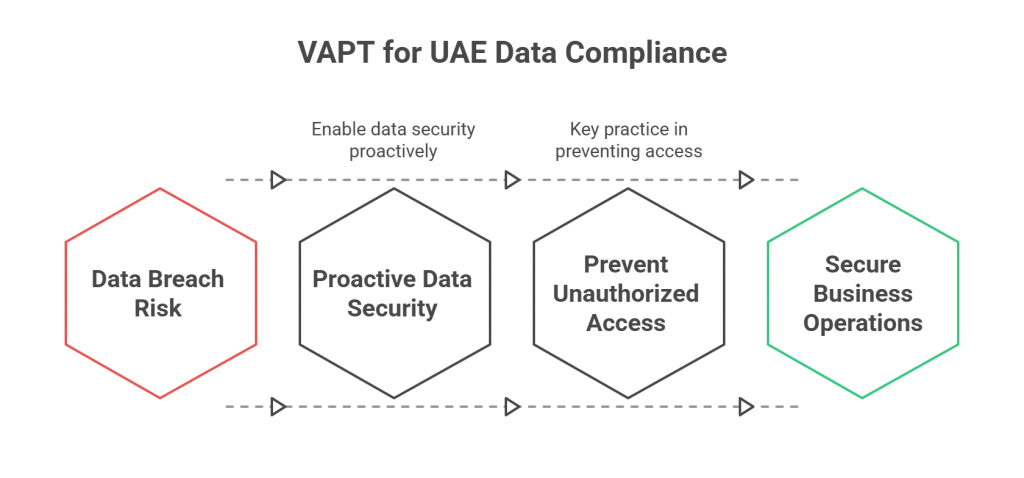
VAPT standard becomes a key practice in preventing unauthorized access in your business in KSA. Ultimately, the data is confidential, and the integrity of your business operations is secured. This procedure proves to be a proactive method in enabling data security with the UAE data compliance.
How Does VAPT Work in Protecting UAE Businesses
Vulnerability Assessment
The first phase of VAPT involves a detailed vulnerability assessment.
At this testing step, your network infrastructure, web applications, servers, and endpoints are assessed. Also, cloud environments are screened to detect misconfigurations, outdated software, and exposed interfaces.
In addition to this, it reviews access control policies, compliance against standards, and internal documentation. The VA process is done to create an inventory of weak points that could serve as potential entry points for attackers.
When considering Article 20 of the PDPL law, the UAE government mandates organizations to take needed technical and organizational measures while processing personal data. And this vulnerability assessment process stands as an initial effort.
Penetration Testing
Post vulnerability identification, the next phase is pentesting. This testing involves simulating a real-world cyberattack.

Penetration testing is performed by ethical hackers by using advanced tools and tactics to exploit these vulnerabilities in a controlled environment. During this process, the professionals identify how far an attacker could go, what data they could access, and how easily they could bypass your security controls.
It is important to monitor unauthorized access and check for breach reports, or else your business might end up facing penalties.
By conducting pentesting, organizations can detect service disruptions, financial losses, and data exposure earlier. This insight helps prioritize which vulnerabilities to fix first, based on the risk they pose.
How to Align VAPT Practices with UAE Data Protection Laws
Legal Framework for VAPT Under UAE Cybersecurity Law
As per the UAE government rule, every business operating in the KSA region that involves collecting and processing data should abide by the Federal Decree Law No. 45 of 2021. This regulation deals with personal and organizational data protection through secure processing, storage, and transmission practices.
The UAE businesses subject to PDPL are responsible for taking technical and organizational measures that keep up the confidentiality and data processing activities. Here, a VAPT security audit serves as an effective practice in adhering with these requirements.
Also Read : VAPT Cost in UAE: What to Expect and Why It’s Worth It
Following regular assessments and simulated cyberattacks will help businesses protect their systems and align strongly with legal expectations. VAPT procedure helps address gaps in configurations, patch management, and unauthorized access controls. This also includes screening third-party integrations that process UAE-based data.
Integrating this practice into your business helps manage areas where lapses could result in legal consequences or financial penalties.
Adhering to Compliance with Security
Performing VAPT assessments allows UAE-based organizations to stay in terms with federal laws and industry-specific standards like ISO/IEC 27001 or PCI-DSS.
Once you do proper documentation, testing protocols, and risk mitigation strategies, your business can present proof of compliance to regulatory bodies, when there is an audit or checks.
Benefits Your UAE Business Gains With VAPT
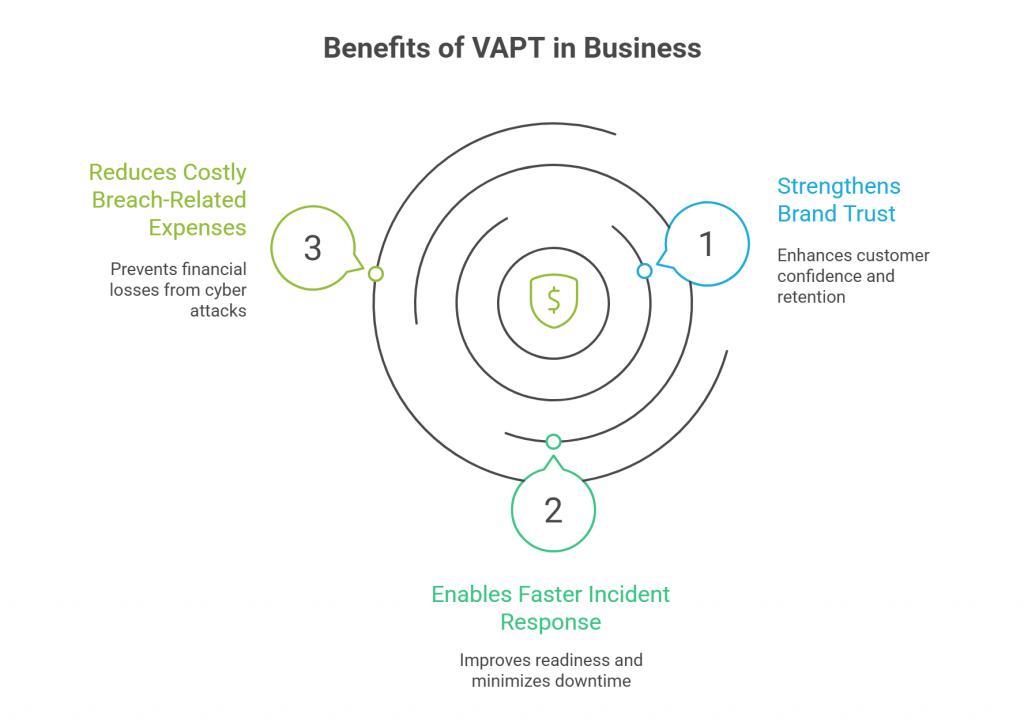
Strengthens Brand Trust and Business Continuity
UAE is now migrating towards digital means rapidly and a single data breach can result in loss of trust, and less customer retention. VAPT helps businesses avoid these pitfalls by identifying and addressing weak spots before attackers take charge. This valuation and testing process protects customer data, helps business continuity, and reinforces stakeholder confidence.
Enables Faster Incident Response
VAPT improves incident readiness. With insights gained from simulated breaches, security teams can fine-tune their response mechanisms, implement stronger access controls, and minimize the downtime when similar real-world attacks happen. This is much effective for industries like finance and aviation, because even a short disruption can have a huge impact.
Reduces Costly Breach-Related Expenses
Cyber attacks go beyond reputational damage and can cost millions in legal fines, recovery efforts, and customer compensation. When you take regular VAPT assessments, you can avoid expenses on penalties.
Also Read : Annual VAPT Checklist for Secure Business Operations in UAE
How to Choose the Best VAPT Services for Your UAE Business?
Choose Proven Expertise
Your VAPT partner should have certified professionals with more experience in detecting vulnerabilities and assessing threats. A skilled team brings practical insights while running a comprehensive evaluation into your systems.
Tool Proficiency And Data Compliance Knowledge
The quality of the tools plays a major role in VAPT assessment. And when it concerns meeting data protection regulation standards in the UAE that requires you to ensure strict data privacy, you are more than expected to leverage the right VAPT tools. Do so should equally consider looking for a VAPT service provider, who is expert in handling the latest testing technologies and methodologies. Efforts here also require evaluating how up-to-date they are with newer strategies in protecting your data.
How Wattlecorp Helps Integrate VAPT with UAE’s Data Protection Regulations
To align VAPT with the UAE data compliance, your service provider should be well-versed in regulations like UAE Data Protection Law or sector-specific mandates. Such experts can help you meet compliance requirements effectively. Here’s where Wattlecorp comes to your aid.
Our team of cybersecurity professionals, who’re also certified pentesters, have also proven knowledge in offering compliance services specific to whichever region or country we provide our service. Coupled with these capabilities are their proficiency in offering VAPT- integrated compliance solutions pertinent to the UAE’s Data Protection Regulatory Standards.
Our customized VAPT services also include:
• Customized Approaches with Transparent Reporting
Every business handles unique digital assets, risk exposures, and data compliance needs. A good VAPT security audit customizes its strategies. Check if the experts can provide personalized solutions based on your industry, infrastructure, and goals instead of offering common solutions.
Furthermore, verify if the solution providers deliver reports transparently. They must communicate the identified vulnerabilities, their severity, and the remedial steps they put forth, so that you can proactively monitor the findings.
• Ongoing Support
One-time evaluation and testing is not a final solution. You can get post-assessment, and mitigation guidance when you choose the right VAPT provider. Also your service provider must follow periodic checks to maintain a strong security posture.
• Evaluate Cost vs. Value
Look for cost-effective solutions that balance affordability and don’t compromise value and reliability. This way, your business can stay secure without overspending.
UAE Data Compliance FAQs
1.Why is VAPT practices crucial for data protection in the UAE?
VAPT serves as a process in finding and fix security gaps in your systems before hackers intrude. In the UAE, where personal data protection is mandatory, businesses must take regular testing to stay safe and compliant. It also builds trust with clients and avoids costly data breaches.
2.What should a UAE-compliant VAPT process include?
A VAPT practice should include risk assessment, vulnerability scanning, penetration testing, and clear reporting. It must align with local laws and ensure sensitive data is not exposed during testing. Finally it must end with fixing the issues.

 AI-Powered Cyberattacks in India 2026: What CISOs Need to Know Now
Key Takeaways: Generative AI has sharply accelerated the attacker’s advantage by making phishing, reconnaissance, and exploit preparation faster and easier to scale. Being a CISO in 2026 means making real-time threat decisions at board level, that’s a different job from what most security leaders are trained for, and the skill gap is already showing. CERT-In’s […]
 ISO 27001 Internal Audit for Saudi Companies: Preparing Evidence Before Certification
Key Takeaways: An ISO 27001 internal audit helps Saudi companies validate whether their Information Security Management System is implemented, not just documented. Certification auditors do not only review policies. They check risk registers, control ownership, access reviews, incident records, supplier reviews, audit trails, management review minutes, and corrective action evidence. For Saudi companies, ISO 27001 […]
 Proactive Threat Hunting for UAE Enterprises: Finding Attackers Before They Strike
Key Takeaways: Proactive threat hunting is not the same as traditional monitoring. Monitoring waits for the alerts, while threat hunting actively searches for signs of attacker behaviour that may not trigger automated detection. For UAE enterprises, threat hunting is becoming more important because attacks are shifting from simple malware to credential abuse, ransomware preparation, cloud […]
 CERT-IN Empanelled VAPT: Why Indian Companies Should Choose CERT-IN Approved Firms in 2026
Key Takeaways: Running a VAPT with a CERT-In empanelled firm means your security testing is backed by a standard that regulators and enterprise clients in India actually recognize, not just a vendor promise. When sensitive data and critical systems are involved, a CERT-In empanelled VAPT provider gives Indian companies compliance readiness they can demonstrate, not […]
 SOC 2 Type I vs Type II Timeline: How Long UAE Companies Actually Need
Key Takeaways: SOC 2 Type I vs Type II timelines differ and it is mostly based on audit depth. Type I checks if controls are well-designed at a given point in time. Type II goes a step further and it proves those controls worked consistently over a defined period. For UAE SaaS companies, Type I […]
 AI Security Testing for US SaaS Platforms: NIST AI RMF and What 2026 Standards Require
Key Takeaways: AI security testing for SaaS platforms isn’t just a technical upgrade from traditional app security. It’s a completely different job. You’re not running a scan on code, you’re stress-testing a model to see how it breaks when someone is actively trying to make it fail. NIST AI RMF isn’t law yet, but your […]